
Hiring an Immigration Paralegal in New York: A 2026 Guide for NYC Law Firms

New York immigration firms run some of the heaviest caseloads in the country — and the support question comes up sooner here than anywhere else. If you’re deciding whether to hire an immigration paralegal in New York, this guide answers the target question directly: what it costs in the NYC metro, how in-house compares to virtual support, and what to vet before you commit.
How much does an immigration paralegal cost in New York?
An immigration paralegal in New York typically costs a firm roughly $8,000–$10,000+ per month fully loaded for an in-house hire, $2,800–$4,000 per month for full-time dedicated virtual support, or $40–$90 per hour for freelance help. The NYC metro runs noticeably above national averages — the U.S. Bureau of Labor Statistics puts median paralegal pay near $62,890 nationally, and New York City compensation sits well above that.
The loaded cost is what matters, because it’s what you actually pay. A New York in-house paralegal carries a metro-premium salary, roughly 30% on top for benefits and payroll taxes, office space at New York rents, and software licenses — landing the real figure near or above $100,000 a year before you spend anything on recruiting and training.
NYC cost comparison at a glance
| Option | Typical monthly cost | Notes |
|---|---|---|
| In-house (NYC metro) | $8,000–$10,000+ loaded | Metro salary premium + benefits + office space + recruiting |
| Virtual dedicated (full-time) | $2,800–$4,000 | Trained immigration support, no NYC office overhead |
| Virtual dedicated (part-time) | $1,500–$2,500 | 80 hrs/mo — the sweet spot for solo NYC practitioners |
| Freelance hourly | $40–$90/hr | Overflow work; inconsistent availability |
Should NYC firms hire in-house or use virtual support?
For most small and mid-size New York immigration firms, virtual support wins on cost and flexibility; in-house wins when you need daily physical presence. The question isn’t which is objectively better — it’s which matches your actual workload and the kind of matters you handle.
Virtual support works for the bulk of immigration casework: form preparation, evidence-packet assembly, case-status tracking, deadline management, client intake questionnaires, and case management updates. None of that requires a desk in your office. The exceptions are genuinely in-person tasks — courthouse or EOIR runs that can’t be digitized, in-person client meetings for sensitive matters, and paper-file handling that your practice still depends on. If most of your paralegal hours are screen work, paying Manhattan office overhead for them is hard to justify.
Time-zone alignment is a non-issue for virtual: reputable providers work your business hours regardless of where their team sits. What does matter is the communication rhythm — a shared task board and a defined daily check-in beat “just email me” every time.
Why do NYC immigration practices have distinctive needs?
New York immigration firms handle higher case volumes, more nationalities and languages, and a heavier docket of EOIR immigration court matters than most markets — which makes specialized support a requirement, not a luxury. A generalist assistant learning on the job becomes a bottleneck fast; a pre-trained immigration paralegal starts productive in week one.
Three things make the NYC practice distinctive:
- Volume and velocity. High caseloads mean deadline tracking and status management aren’t background tasks — they’re the central operational challenge. Missed filing windows have real consequences for clients.
- Language and document diversity. NYC firms routinely handle cases from dozens of countries, with foreign-language documents, translations, and country-specific evidence requirements. Support staff need to know how evidence packets get assembled properly, not just where the forms are.
- EOIR and court-adjacent work. Firms with detained and non-detained immigration court matters carry scheduling complexity — master calendar hearings, individual hearings, filing deadlines — on top of USCIS petition work. Someone has to track all of it, and attorneys shouldn’t be the someone.
This is exactly the workload profile where trained immigration paralegal support earns its cost: the work is specialized enough that generalists create training drag, and high-volume enough that attorney time spent on administration is the firm’s most expensive labor.
What should New York immigration firms look for?
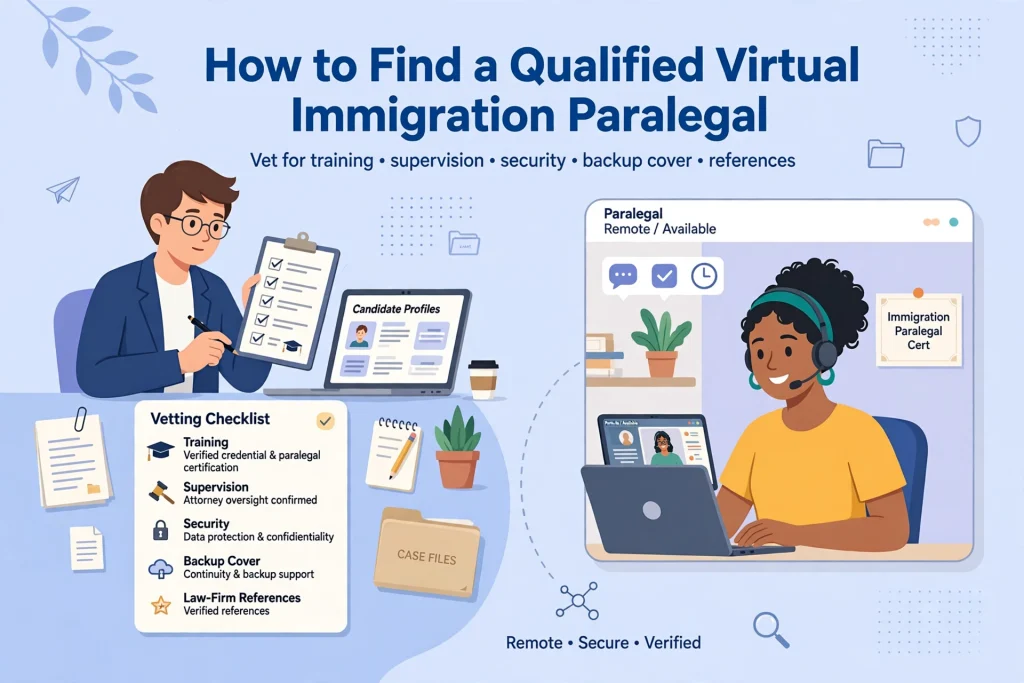
Look for five things: specific immigration training, a clear attorney-supervision model, real data-security practices, backup coverage, and references from New York or tri-state law firms. Each one filters out a different kind of bad fit.
- Immigration training specifics. “Trained” should mean a curriculum you can name: USCIS forms and edition dates, evidence-packet standards, priority-date and receipt tracking, intake questionnaires that capture the right facts the first time. Ask for the specifics, not the adjective. (SMY Solutions paralegals are AILA-trained — trained through American Immigration Lawyers Association programs and resources.)
- Attorney-supervision model. Every paralegal — in-house, freelance, or virtual — must work under a licensed attorney’s direction. Ask who reviews drafts, who signs off, and how errors get caught before they reach a client file.
- Data security and NDA practices. Your support team touches client contracts, passports, financial records, and sensitive personal histories. Look for encrypted systems, device policies, and a signed NDA — not vague reassurances.
- Backup coverage. When your assistant is sick or on leave, who does the work? A serious provider has a trained bench and a handoff protocol. A solo freelancer has an out-of-office reply.
- Local client references. Ask to speak with two current law-firm clients in the New York area. An attorney in Queens or Manhattan who has used the service for six months will tell you more than any landing page.
Can a virtual paralegal serve a NYC firm?
Yes — the vast majority of immigration paralegal work is location-independent, and virtual support serves New York firms every day. Form preparation, evidence review, deadline tracking, intake, and case management updates all happen in software, not in a room. EOIR hearing schedules and USCIS filing dates don’t care where the person tracking them sits.
The honest exceptions: if your practice needs someone physically at immigration court, running in-person client intake, or managing paper files that can’t go digital, you need local boots on the ground. Many NYC firms solve this with a hybrid — virtual support handling the casework volume, and an in-office presence only where physical presence is genuinely required. That’s often cheaper than a full in-house hire and more reliable than a freelancer.
Frequently asked questions
Do I need a paralegal located in New York?
Usually not. Immigration paralegal work — drafting, filing preparation, tracking, intake — happens in software and doesn’t require a New York address. You need a New York presence only for genuinely in-person tasks like court runs or in-office client meetings. For most firms, a virtual assistant working your business hours covers everything else at a fraction of the loaded in-house cost.
Is it ethical to use virtual paralegal support for immigration work?
Yes. Legal ethics rules permit outsourcing paralegal work provided the firm maintains attorney supervision, protects client confidentiality, and ensures the work product meets professional standards. The supervision requirement applies to every paralegal — in-house, freelance, or virtual — and a reputable provider builds it into the model rather than treating it as optional.
How fast can immigration paralegal support start?
Typically within one to two weeks of engagement — onboarding to your case-management system, intake templates, and communication rhythm. Compare that with in-house hiring in New York: posting, interviewing, background checks, and notice periods commonly take 6–10 weeks before a hire is productive, plus another 2–4 months of immigration-specific training before they’re net-positive.
What does an immigration paralegal actually handle day to day?
Document drafting and filings, case-file organization and evidence-packet assembly, client intake and communication under attorney supervision, deadline and case-status tracking, and general administrative casework. For a deeper breakdown, see our related post on what immigration paralegal support for law firms covers in practice.
What does it cost to get started?
Most providers can start with a part-time dedicated arrangement in the $1,500–$2,500 per month range — typically 80 hours with one named assistant who learns your systems. That’s the lowest-risk way for a solo or small NYC firm to test the model before committing to full-time support.
Talk to a team that’s already in New York
SMY Solutions is based in Brooklyn, NY — not a faceless marketplace, a local team that understands how New York immigration firms actually work. If your attorneys are spending their days on case administration instead of strategy, or you’re about to start another 3-month hiring cycle, let’s talk about what trained immigration paralegal support could take off your plate.
Book a free session to see how our AILA-trained immigration paralegal assistants work in practice — or start with our related read, Immigration Paralegal Support for Law Firms: What We Handle, for the full breakdown of tasks our team covers.


Comments (0)
No comments yet. Be the first to share your thoughts.