
How to Hire a Virtual Immigration Paralegal: The First 30 Days, Step by Step

Hiring a virtual immigration paralegal works best in four steps: vet the provider, set up security and access, start with a defined set of tasks in week one, and expand only after the first review. With an already-trained paralegal, productive work starts in days — not after months of training.
This guide covers what happens *after* you decide to hire. For the questions to ask before you decide, see Immigration Paralegal Support for Small Firms.
Step 1: Decide what to delegate first (before day one)
Do not hand over “everything” on day one. Pick the bottleneck:
• Intake and document chasing, if cases stall waiting for client documents.
• Form preparation, if attorneys spend hours on I-130 / I-485 / N-400 drafting.
• Deadline tracking, if dates have slipped or live in someone’s memory.
• RFE assembly, if responses are rushed and incomplete.
Write it down as a short list. That list becomes the first-week plan, and the measure of whether the hire is working.
Step 2: Set up security and access (days 1–3)
Before any client file is touched:
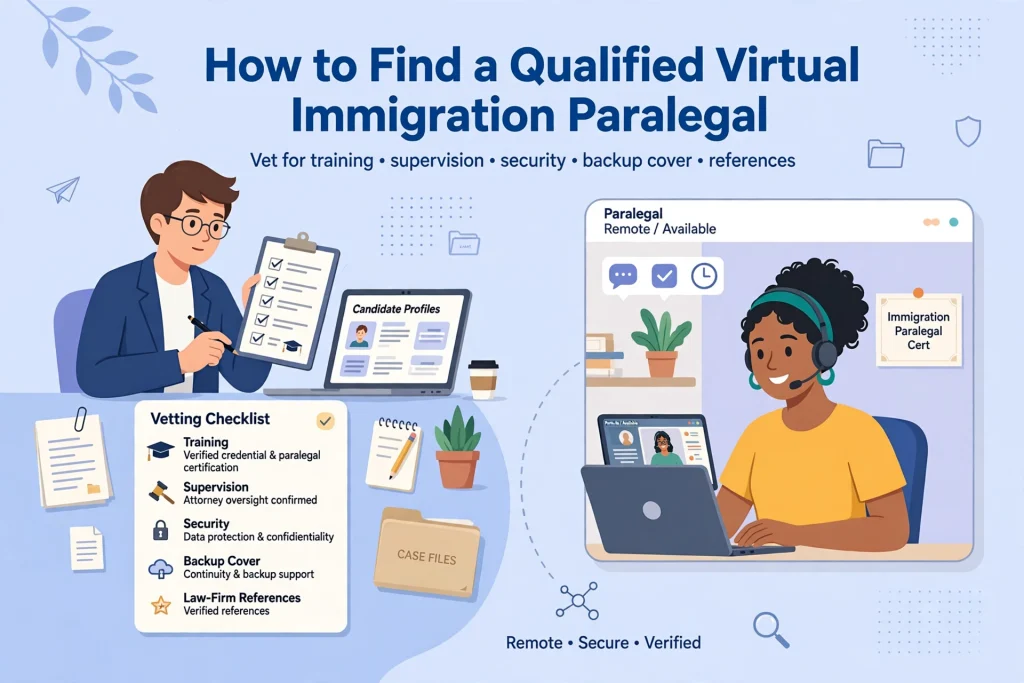
• Signed NDA and agreed data-handling rules.
• Encrypted storage and communication — no client documents by personal email or unsecured drives.
• System access to your case management system, calendar, and filing tools, with permissions limited to assigned cases.
• A named supervisor — the attorney who reviews filings and answers legal questions.
This setup is the difference between remote support and remote risk. It should be documented, not assumed.
Step 3: Week one — defined tasks, daily check-ins
Week one should produce finished work, not just orientation.
A good first week looks like this:
• Day 1–2: Orientation to your case management system, naming conventions, and checklist templates. No client work yet, or only supervised intake review.
• Day 3–5: First assigned tasks from your bottleneck list — for example, intake questionnaires on two cases, or document checklists and follow-ups. The paralegal prepares; the attorney reviews.
• Daily check-in: A short update — what was completed, what is blocked, what needs attorney input. Fifteen minutes beats a weekly surprise.
Because SMY paralegals are AILA-trained — trained through American Immigration Lawyers Association (AILA) programs and resources — week one is not spent teaching USCIS form families, edition dates, or evidence standards. That training already happened. Week one is spent learning *your* firm’s systems and preferences.
Step 4: Weeks 2–4 — expand by review, not by hope
Expand only after a review at the end of week one and week two:
Review point | Check
End of week 1 | Tasks completed on time? Checklists accurate? Communication clear?
End of week 2 | Attorney review time falling? Documents arriving faster? Deadlines logged?
End of week 4 | Is the bottleneck smaller? What is the next task family to add?
Add one task family at a time: intake, then forms, then evidence, then RFE support, then deadline ownership. Firms that add everything at once get confusion. Firms that add by review get a system.
What should the attorney still do in the first 30 days?
• Review every filing before submission, and sign where required.
• Answer legal questions routed by the paralegal — never delegate legal advice, strategy, or representation.
• Set the standard for a complete file: what a ready-to-review package looks like in your firm.
• Give feedback early. Correct a checklist format in week one, not in month three.
The rule from the start: the paralegal owns the *how* and the *when*. The attorney owns the *what* and the *why*.
Common first-30-days mistakes
• No named supervisor. Work goes to “the firm” and no one reviews it.
• No backup plan. The assistant is away and no one monitors deadlines.
• Too many tasks at once. Nothing is done well, and the firm concludes remote support “doesn’t work.”
• No security setup. Client documents move through personal channels because the secure route was never set up.
Each of these is preventable in the first three days, and expensive to fix later.
Frequently asked questions
How fast can a virtual immigration paralegal start?
With SMY, in days. In-house hiring takes 6–10 weeks plus 2–4 months of training. The gap is training: SMY paralegals arrive AILA-trained.
Should I hire full-time or part-time first?
Start with the hours your bottleneck needs. Many solo and small firms start part-time or dedicated on a defined task set, then expand as volume grows. See Virtual Immigration Paralegal Pricing Models Explained in this series.
What if it is not working in week two?
Raise it at the week-two review with specifics: which tasks, which standard, what was missed. A good provider adjusts the workflow, the checklist, or the task mix — it does not ask you to wait three months.
The bottom line: hiring well is not about finding the perfect person. It is about a clear first task list, documented security, daily check-ins in week one, and expansion by review. Do those four things, and the first 30 days build a system instead of a dependency.
Ready to start? Book a free session with SMY Solutions, Brooklyn, NY, (929) 327-5878, and bring your bottleneck list — we will map the first 30 days for your caseload.


Comments (0)
No comments yet. Be the first to share your thoughts.