
Virtual Immigration Paralegal: The Complete Guide for Law Firms (2026)

A virtual immigration paralegal is a trained paralegal who supports an immigration law firm remotely, handling intake, USCIS form preparation, evidence packets, and deadline tracking under attorney supervision. The firm gets dedicated casework help without hiring in-house, renting office space, or training a generalist for months.
If your attorneys spend their days on forms and follow-ups instead of strategy, this guide explains the model in full: what it covers, how supervision works, what it costs, and who it fits.
What does a virtual immigration paralegal do?
A virtual immigration paralegal handles the administrative backbone of immigration casework remotely: intake questionnaires, document collection, USCIS forms, evidence assembly, RFE responses, priority-date tracking, and deadline calendars — all under attorney supervision.
The work is the same as an in-office paralegal. Only the location changes. Files, case management systems, and client communication are all digital in modern immigration practice, which is why remote support works so well for this work.
The 12 core tasks are: intake questionnaires, document collection and chasing, client status updates, biometrics scheduling, I-130 / I-485 / N-400 preparation, edition-date and fee verification, evidence packets, RFE response assembly, country-condition research support, priority-date tracking, receipt and case-status monitoring, and hearing and deadline calendars. See the full breakdown in What Does an Immigration Paralegal Do?
What does a virtual immigration paralegal NOT do?
A virtual immigration paralegal does not give legal advice, set case strategy, sign filings, or represent a client before USCIS, EOIR, or any court.
That line is the point of the model, not a limitation. The paralegal owns the how and the when: how forms get completed, when deadlines hit, how evidence is organised. The attorney owns the what and the why: what relief to seek, why an argument works, and whether a filing is legally sound. When a client question crosses into legal territory, a trained paralegal routes it to the attorney instead of answering it.
How does supervision work remotely?
Supervision works the same way it works in an office, with clearer checkpoints:
- Attorney review before filing. The paralegal prepares a complete, organised package. The attorney reviews, signs where required, and takes responsibility for the submission.
- Daily communication. Status updates, document checklists, and deadline alerts, on a schedule the firm sets — not when someone remembers to ask.
- One owner per file stage. Intake, preparation, evidence, and tracking each have a named owner, so nothing sits in a shared inbox with no one responsible.
Firms that get this workflow right find attorney review time drops, because the attorney checks finished work instead of building it from scratch.
Virtual vs in-house: what is the real difference?
| Virtual (dedicated) | In-house | |
|---|---|---|
| Time to productive work | Days, if already immigration-trained | 6–10 weeks to hire, plus 2–4 months training a generalist |
| Fully loaded cost | 2,800–4,000/month (SMY dedicated support) | About 7,500/month;8,000–$10,000+/month in NYC |
| Office overhead | None | Desk, equipment, benefits, management time |
| Backup cover | Built in with a provider | Depends on the firm hiring a second person |
| Training burden | Falls on the provider, before the firm | Falls on the attorney |
The full cost breakdown is in Immigration Paralegal Cost: 2026 Pricing Guide.
Why does immigration-specific training matter?
Immigration work punishes inexperience. Form edition dates change, RFE patterns shift by service centre, the Visa Bulletin has its own logic, and filing fees and lockbox details all have specifics a generalist learns only by making mistakes — and in immigration, mistakes cost clients months or their status.
That is why SMY Solutions trains its paralegals before they touch a client file. SMY paralegals are AILA-trained — trained through American Immigration Lawyers Association (AILA) programs and resources, covering USCIS form families and current edition dates, evidence-packet standards that survive RFEs, filing cadence, and deadline discipline. “Trained” is a claim. AILA-trained is a curriculum you can check.
Who is a virtual immigration paralegal right for?
- Small and solo firms that cannot justify a full-time in-house hire but lose attorney hours to admin every week.
- Growing firms with rising volume, where intake and evidence work is the bottleneck, not legal expertise.
- NYC firms with high volume, more languages, and EOIR dockets on top of USCIS work — the profile where trained remote support pays for itself fastest. See Hire an Immigration Paralegal in New York.
- Any firm where deadlines or documents have slipped because no one owned the docket.
It is not right for a firm that needs someone physically in court every day, or for work that requires in-person intake and paper files that cannot go digital. For that, the hybrid model works best: virtual for casework volume, local only where physical presence is genuinely required.
Frequently asked questions
Is a virtual immigration paralegal secure?
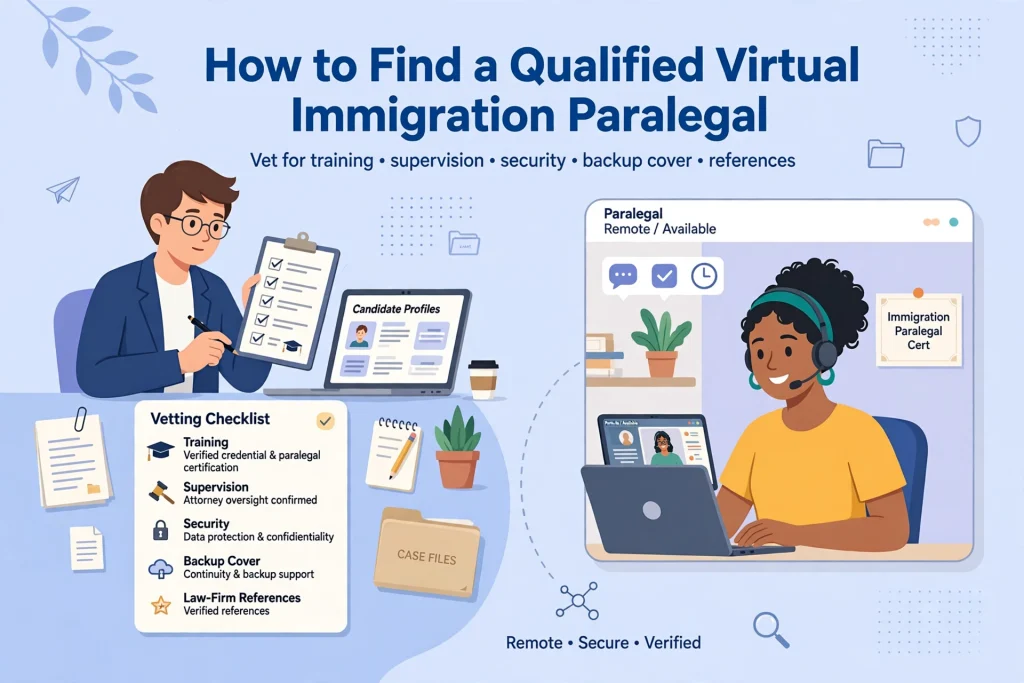
Yes, when the provider’s practices are documented: signed NDAs, encrypted storage and communication, and device-level security policies, agreed in writing before work starts. Ask for specifics, not reassurances.
Can a virtual paralegal work in my firm’s time zone?
SMY support works on your business hours. The point of dedicated support is that it fits your firm’s day, not the other way around.
How fast can support start?
AILA-trained support from SMY starts in days, not the 6–10 weeks in-house hiring takes, because training happened before the assignment, not on your files.
What if my assistant is unavailable?
Ask any provider this before you sign. With SMY, backup coverage is part of the model, so receipts, deadlines, and client messages are still monitored. See the full hiring checklist in Immigration Paralegal Support for Small Firms.
The bottom line: a virtual immigration paralegal is not a cheaper generalist. It is a trained specialist, working remotely, who takes the administrative lifecycle of a case off the attorney’s plate — so the attorney spends time on judgment, strategy, and clients.
If your firm is losing attorney hours to casework admin, see how trained support works on our Paralegal Assistants service page, or book a free session. SMY Solutions is based in Brooklyn, NY. Call (929) 327-5878.


Comments (0)
No comments yet. Be the first to share your thoughts.